
Parotid gland surgery carries the risk of "Gustatory Sweating" and facial hollowing. Dr. Manish Tiwari prevents these complications entirely by utilizing advanced Deep Cervical Fascia and SMAS rotational flaps to reconstruct the surgical bed flawlessly.
Profuse sweating on the cheek and near the ear occurring specifically while chewing or eating food.
Sudden redness and warmth on the side of the face during meals, a classic sign of Frey's Syndrome.
Embarrassment caused by visible sweating and flushing while eating in public or social settings.
A sunken, hollowed-out appearance on the jawline where the parotid tumor was removed.
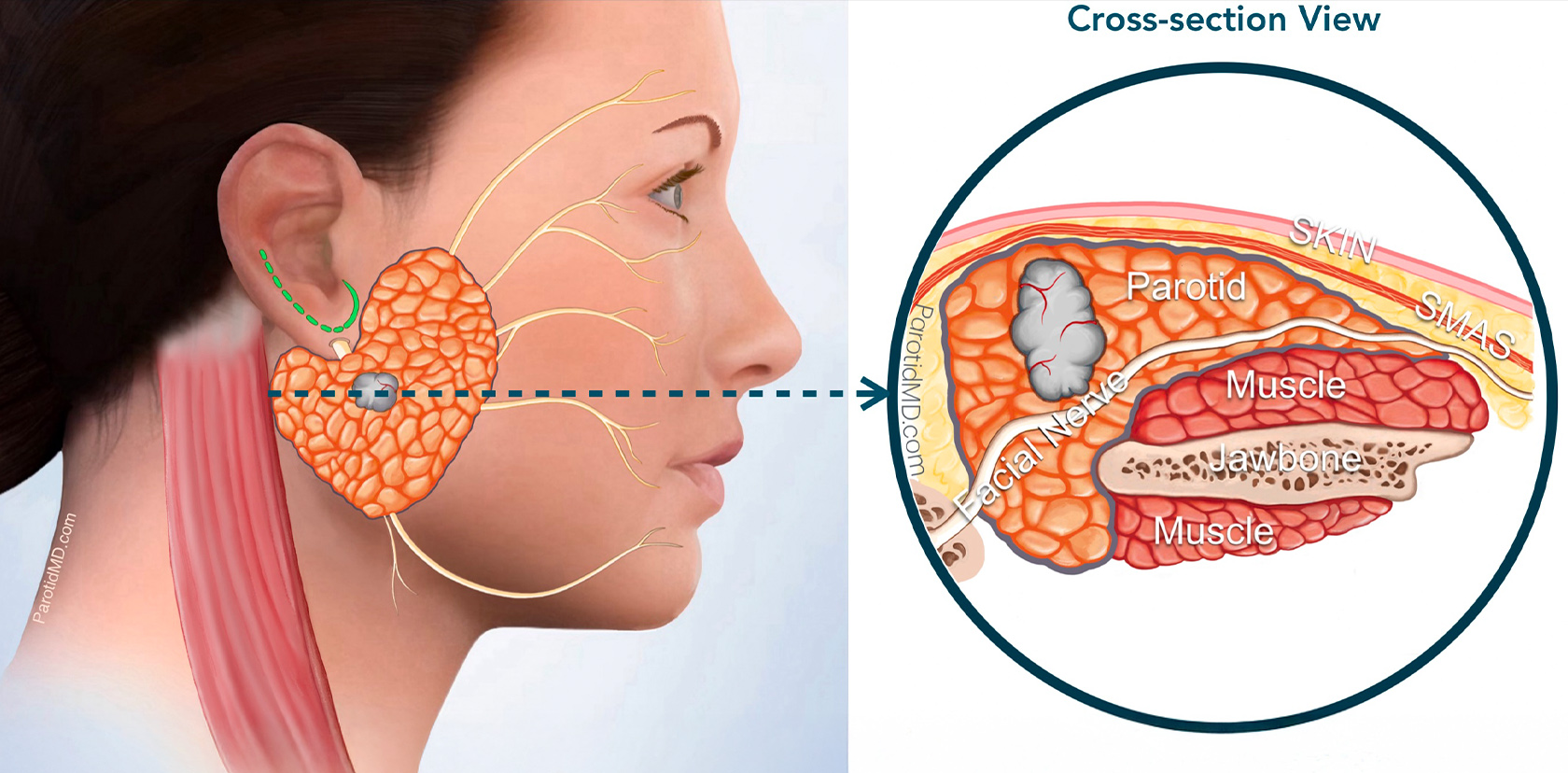
Frey's syndrome happens when the microscopic nerves that used to produce saliva mistakenly heal by attaching to the sweat glands in your skin. Dr. Tiwari stops this by creating an impenetrable biological barrier between the nerves and the skin.
Instead of just closing the skin after removing the parotid tumor, Dr. Tiwari carefully elevates a thick layer of local fascia (connective tissue) from the neck. This tissue is rotated up and stitched securely over the exposed parotid bed.
The Superficial Musculoaponeurotic System (SMAS) is a layer of tissue under the facial skin. By folding the SMAS tissue down into the surgical cavity before closing the wound, we achieve two incredible benefits simultaneously.
By combining nerve-sparing techniques with deep fascia flaps and SMAS rotational flaps, Dr. Tiwari elevates a standard tumor removal into a "Cosmetic Parotidectomy," ensuring the patient looks and feels normal post-surgery.
This reconstructive step adds only 20-30 minutes to the overall parotid surgery, but provides a lifetime of cosmetic and functional benefits.
The benign parotid tumor is successfully removed while carefully monitoring and preserving the facial nerve, leaving a hollow surgical bed.
Dr. Tiwari isolates the Deep Cervical Fascia or the SMAS layer adjacent to the defect, preserving its local blood supply to ensure it remains healthy.
The fascia is rotated over the exposed salivary nerves and stitched into place, filling the cavity and acting as a physical shield before the outer skin is finally closed.
If you have already had parotid surgery elsewhere and are experiencing sweating, we can diagnose it.
The addition of the fascia flap does not significantly change your recovery time.